Well the dust has almost settled and things are working good, there are still a couple of issues but all-in-all I think that the new system will be a definite improvement. 

During the upgrade I changed forums and if you were a member previously I sincerely apologize but you will have to re-register because the new forum was unable to import any user information from the previous forum.

In closing I want to thank everyone that has provided feedback and encourage others to join in and use the new forum.

Thanks=>Mike

C++ and the L298N Dual Full-Bridge Driver

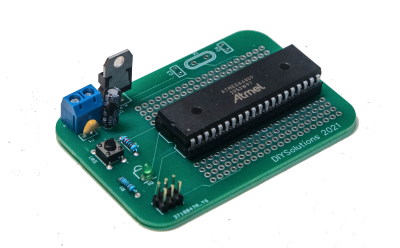
For the past couple of years I've been developing projects for the Atmel line of micro controllers using the GNU toochains Asm and C languages. Until recently C++ was very difficult if not impossible using the previous versions of Atmel's IDE, but that's no longer an obsticle with the new version, Atmel Studio 6.1 which is available here. I prefer the power of C++ and have missed being able to use it in my projects, there are still some issues using C++ in projects such as interrupts but there are work arounds and it's not a deal breaker. Another consideration why I wasn't using C++ was that the ATmega development boards were rather expensive upwards of $50+ but recently the price of knockoff ATMega1280/2560 boards have come way down, to around $17 and they function as well as the originals, at least I haven't had any problems with them.

C++11 standards for AVR

I've been using Ateml's IDE for some time now and have long awaited the time when C++ would become a viable programming option and now with Atmel Studio 6 they have finally made this a reality. The latest version of Atmel Studio is 6.1 that uses the GCC 4.7.2 version toolchain, which in Atmel's lingo means the compilers and linker used to build projects in the IDE.

SPI Communications Primer
The Serial Peripheral Interface (SPI) or four wire serial bus as it is sometimes referred to is a syncronous serial data protocol operating in a master/slave configuration in full duplex mode. It is used by microcontrollers for communicating with one or more peripheral devices quickly over short distances. You can also think of SPI as being built around a double buffered 8-bit shift register with both ends of the shift register brought out to MCU pins.
Extensibility 101

I've been asked to provide some insight into Visual Studio Extensibility and since it is such a huge subject I've decided to break it down into a series of acticles starting with the basics and branching out into different areas depending on interest (yours and mine) so if you have a particular area that you would like me to write about please leave me a message and I'll do my best to get something on paper. Also if you have any questions feel free to message me and I will get back to you. The response to your questions depends on the amount of information you provide me!

Motor Primer and the L293D Quad Half-H Driver

There are many ways to drive small current motors, those requiring 500mA or less but the L293H Quadruple Half-H driver is a verstatile chip that was designed for use with motors, can very easily be controlled with a micro-controller and can be purchased [here]. Using this chip we can drive either 2 DC motors or one Stepper motor and we will learn how to do both in this tutorial. The components needed to complete this excerise are an ATMega328p Micro-controller to interface with and control the L293D device but any controller may be used, the L293D component and one dc motor and/or one stepper motor.